Reference Data in Dataedo
Introduction
Reference Data is essential for organizing, classifying, and labeling other data in a consistent manner. Also referred to as codes, lookups, lists of values, or domains, reference data is a subset of Master Data that plays a vital role in ensuring data quality. Common examples of reference data include countries, currencies, account types, units of measure, organizational departments, statuses, and calendar periods.
Using Dataedo's reference data, you can organize your lookups with detailed lists of allowed values and their corresponding formats, making it easier to manage and maintain consistency. Additionally, Dataedo provides the ability to trace which database columns use values from a specific lookup, which increases transparency:
- Describing values existing in columns - Dataedo will show you what values can be found in linked columns and what they mean.
- Showing possible values for your Business Glossary term - besides the usual term definition you will get possible values that represent that term in your data.
- Lookups exist on the Database Level. If you wish, you can create a Manual Database to store your lookups in a single place.
- Nom matter where they are stored, you can use lookups in every database documentation in your repository.
- Each column can be linked to one Lookup, but one Lookup can have links to many columns.
Lookup View
Currently, Dataedo Portal displays only the values grouping
In Portal, you can find lookups in Catalog>Reference data
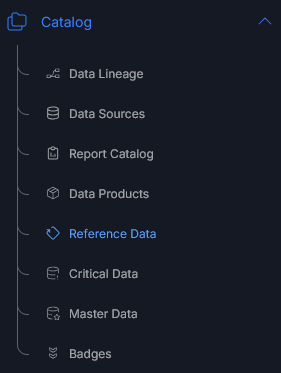
In the Reference Data view, you have to first choose one of the Databases where your lookups are stored, then you can click on a specific lookup to open its view.

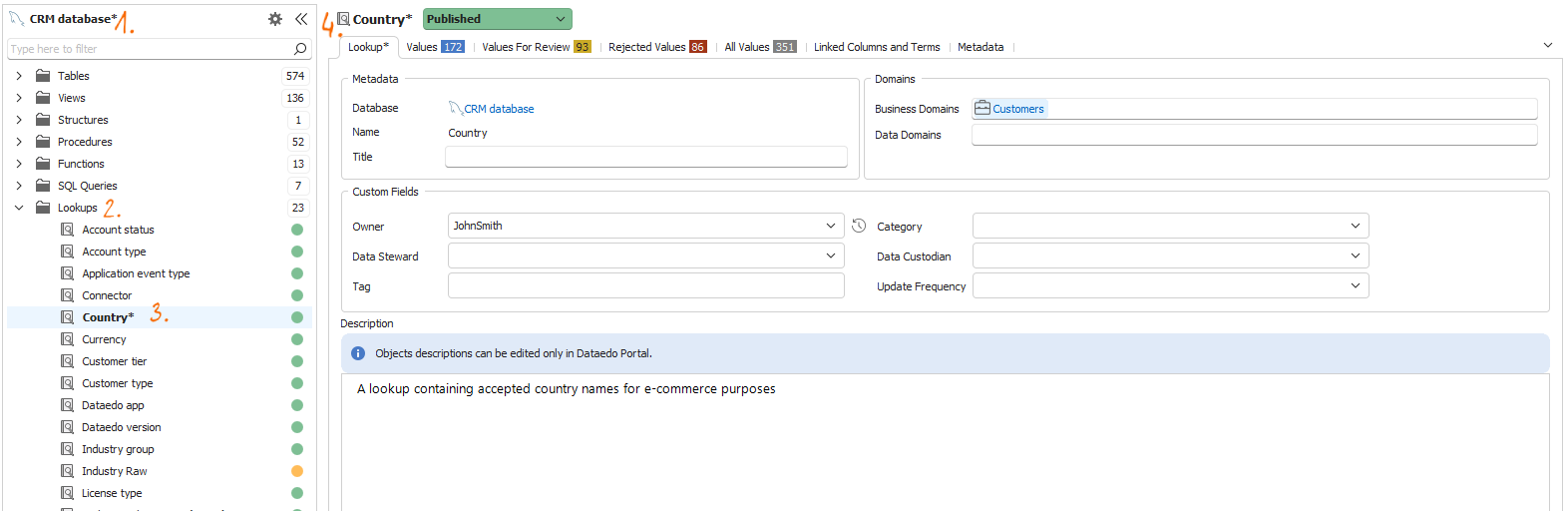
In Desktop, the lookups folder [2] is stored in its Database's [2] documentation. Selecting any Lookup (Country in example [3]) will display its detailed view [4].
Lookup Values
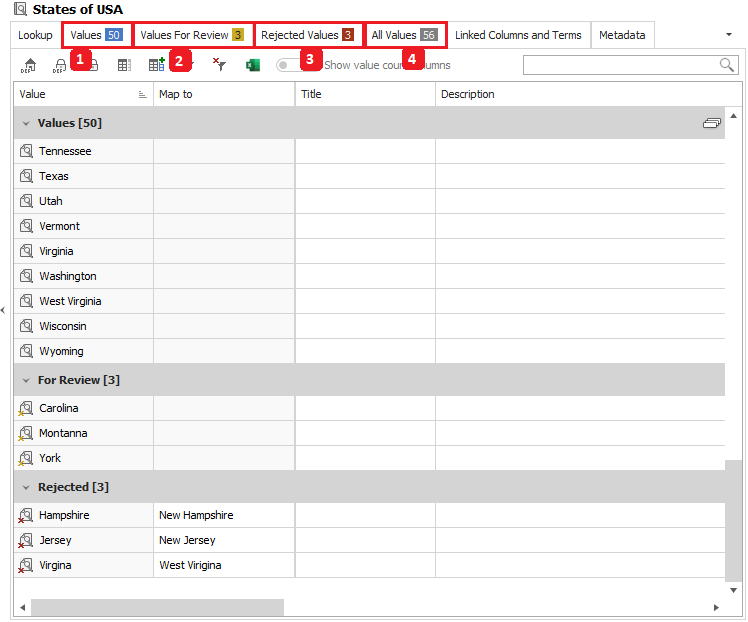
Lookup Values are divided into 3 different logical groups represented by individual tabs:
- Values (1) - values that were added manually by the editor and values loaded from columns linked to Lookup that were accepted by the editor.
- Values For Review (2) – values fetched from linked columns that need to be reviewed and accepted. These values are not considered in exporting and searching.
- Rejected Values (3) – values marked as invalid. Rejected values go with Map to parameter which is a suggestion of what is the correct value of the rejected one. These values are not considered in exporting.
- All Values (4) shows all values from groups listed above in one place.
Dataedo will not modify data in your source database automatically. Values stored in Dataedo are for informational purposes only.
Workflows and Steward Hub
Lookups can be put through different Workflow stages. This allows you to efficiently track status of different lookup's validity and relevance for your business and data governance purposes, and ensure that only certified and polished lookups are available to the whole organization. The lookup's current workflow status can be viewed and edited by Data Stewards directly underneath its name.
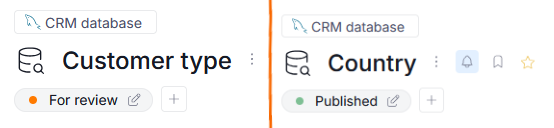
You can review the lookups that are not yet in a published status from the Steward Hub.
Data Classification
Since lookups can store an array of accepted values, you can also use them as a basis for automated Semantic Type detection and custom Data Classification. Learn more here.

