Google Gemini models
Follow the steps below to configure the AI Autodocumentation feature in Dataedo with Google Gemini models.
Prerequisites
To use the AI Autodocumentation feature with Google Gemini, you must generate an API key in Google AI Studio. It is required to access the Gemini API and use the Gemini models for autodocumentation.
You will also need the Admin role in Dataedo Portal to add the engine, and (Power) Data Steward permissions to the Dataedo Repository to create AI-generated descriptions.
Google AI Studio
Generate an API key from Google AI Studio
- Go to Google AI Studio and sign in with your Google account.
- Open the API keys page.
- Create a new API key. If you are asked for a Google Cloud project, select an existing project or create a new one.
- Copy the API key to your clipboard.
Configure AI autodocumentation in Dataedo
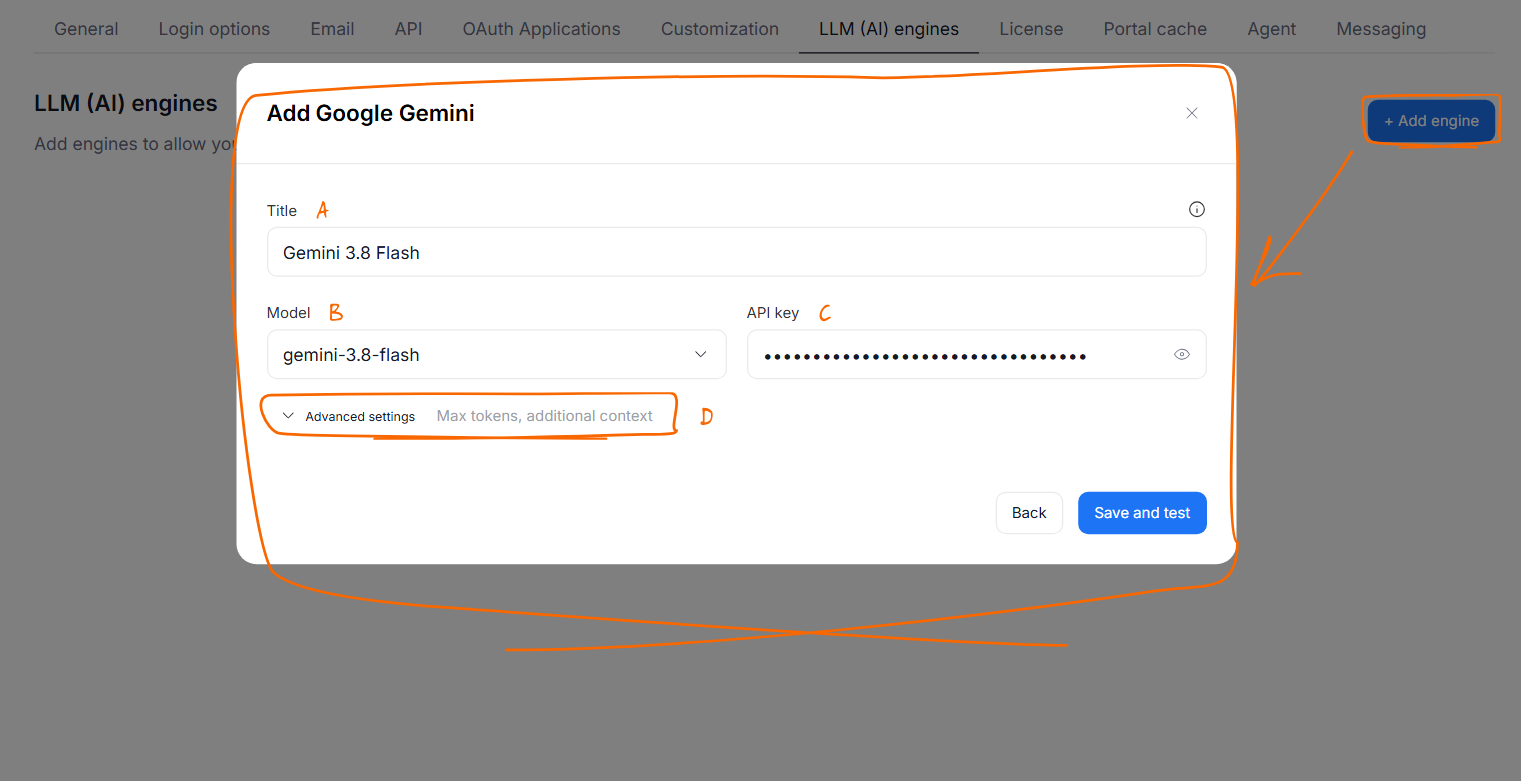
- In Dataedo navigate to Settings > System Settings > LLM (AI) engines.
- Click + Add engine.
- In the New engine window, select Google Gemini.
- Fill in the engine details:
- Title [A]: a user-friendly name shown to users when they choose an engine, for example
Gemini 3.8 Flash. - Model [B]: select Gemini 3.8 Flash. To use another Gemini model, select Enter custom model... and type its model ID.
- API key [C]: paste the API key from Google AI Studio.
- Title [A]: a user-friendly name shown to users when they choose an engine, for example
- (Optional) Expand Advanced settings [D] to change Max tokens (default
4096) or to add Additional context for the prompts. See Add an AI engine for details. - Click Save and test.
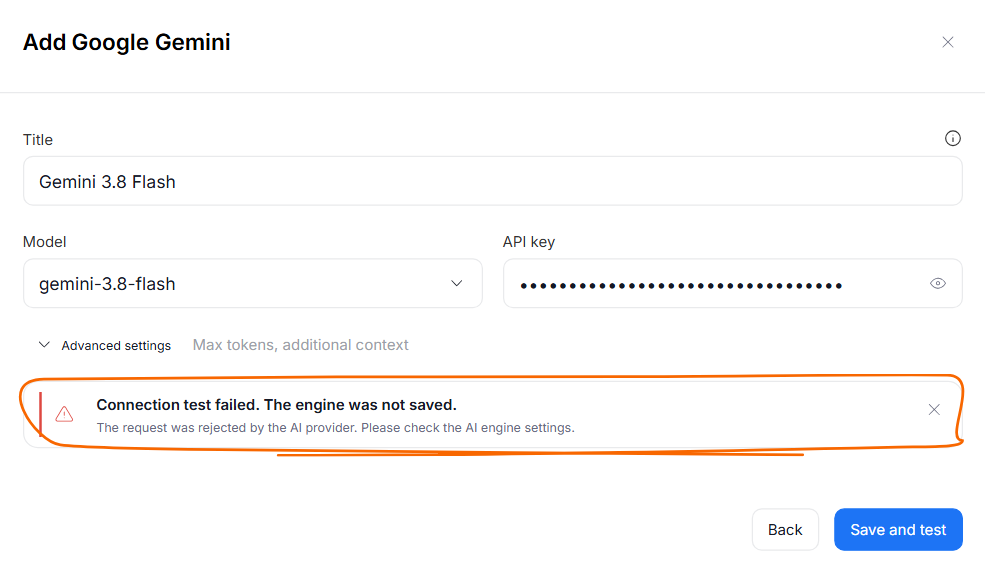
Dataedo Portal sends a short test prompt to Google Gemini and saves the engine only if it responds. If the test fails, check the error message, correct the settings, and click Save and test again.
Dataedo connects to Gemini through its OpenAI-compatible API at https://generativelanguage.googleapis.com/v1beta/openai/. The endpoint is not configurable.

