Term relationships
Using the Dataedo Glossary, you can define relationships between Terms. Relationships codify how terms relate to each other, and help you build a consistent and complete network of dependencies in your business vocabulary. Each relationship has:
- A type, which determines what is the relation between two terms
- A direction, defining the subject and the object of a relationship (for example
Ais a substitute ofB) - (Optional) user comments, containing all extra context related to a relationship
Basic relationship types
The pre-defined relationship types in Dataedo are:
- Related term
- Replaces/Is replaced by
- Has a preferred synonym/Is a preferred synonym of
- Contains/Is contained in
- Uses/Is used by
- Is used to calculate/Is calculated from
- Has a type/Is a type of
- Parent/Child
Custom relationship types
Admins can add different types of terms in the glossary_term_relationship_types table in the Dataedo repository database.
Parent/Child relationship
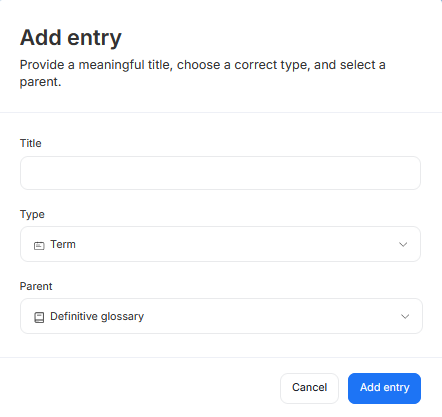
The Parent/Child relationship is established during term creation, and is essential in building the Glossary's hierarchy. When you define a term, you must provide its parent. The new entry will be tagged as a child of a selected parent. Each term can have only one parent, but multiple children.
You can change a term's parent after its creation, using the Edit button under the parent relationship section.
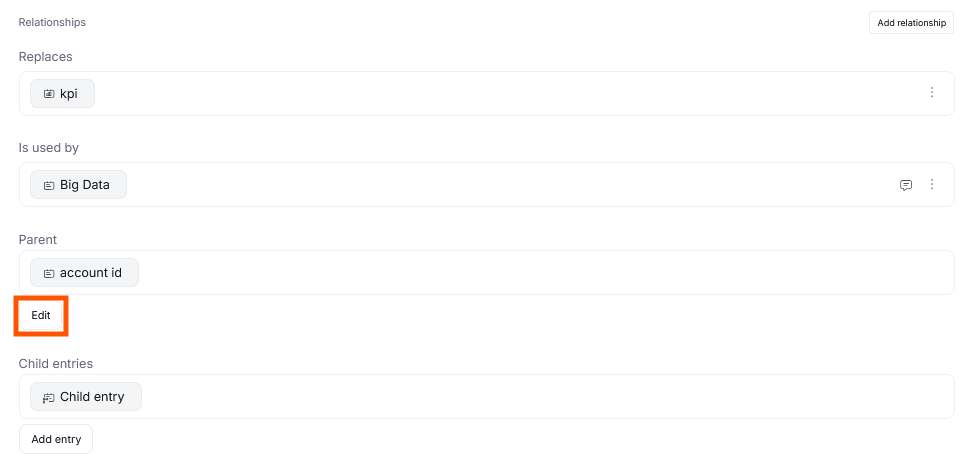
Changing the parent moves a Term to a new place in the hierarchy. All of its children will be moved there as well.
Defining other relationships
Once a term is created, you can open its view and click the Add Relationship button in the overview section.
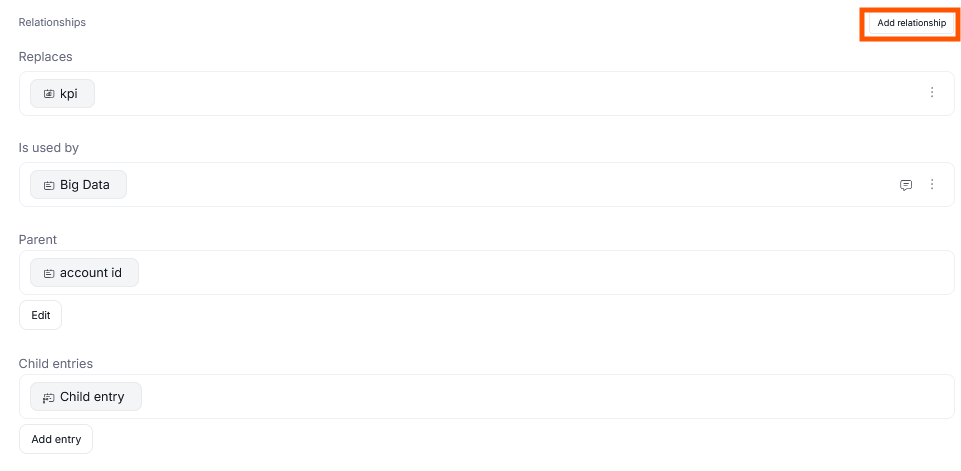
Once this is done, you have to select whether you want to add a parent term a child term or a related term.

This opens a pop-up where you can define a new relationship. You must specify the related term and the type of relationship. You can also add a comment if the relationship needs more context.
Relationships are reciprocal. This means that if you take a productivity term and establish an is used to calculate relationship between it and performance metric, the inverse will be automatically created too — performance metric will have an is calculated from relationship established with productivity.
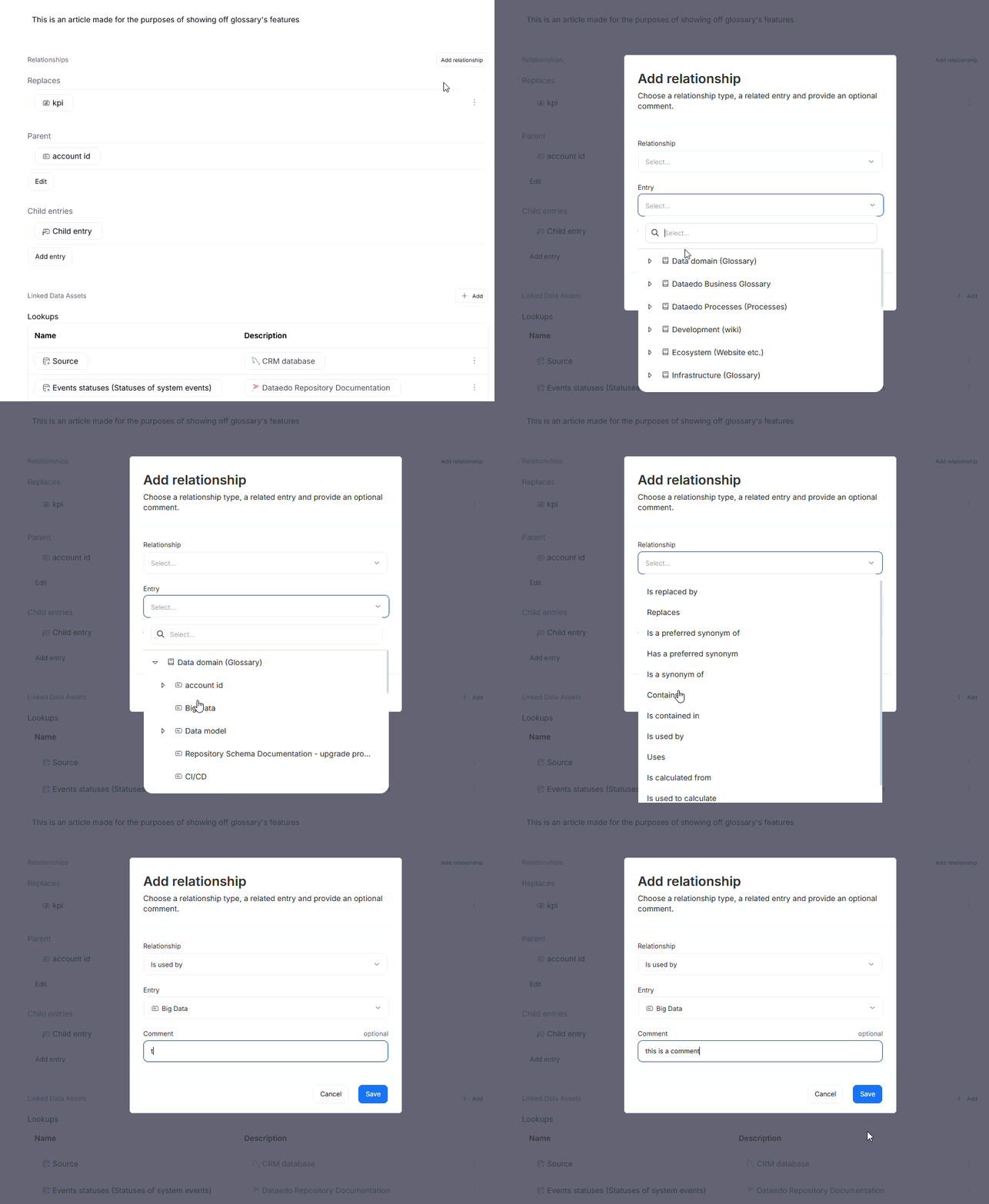
Editing relationships
Saved relationships are shown under the related term section of the overview. Each saved relationship displays a three dots, and a comment (if defined). Hovering over the comment icon will display the comment saved for that particular relationship.
Clicking on the three dots open a relationship menu. There, you can use the delete button to delete the relationship (but not the related term itself), or edit a comment.

Relationships Diagram
Related Terms are displayed on a grid by default. You can, however, switch to a Diagram view using a toggle [A] on the top right side of the Relationships section.
In the diagram view, new relationships can be added using the plus icon [B] next to your term's representation.


