Descriptions
Descriptions can be edited only in Dataedo Portal
Every object in Dataedo repository has a description field. Descriptions help you to keep track of any additional information and context surrounding metadata gathered in your catalog.
Adding descriptions
To add a description in Portal, simply open an object and navigate to its About section. If no description has been added yet, you will see an empty description field with a text encouraging you to type in a description; otherwise you will see the description itself. Click on it to start the editing process.
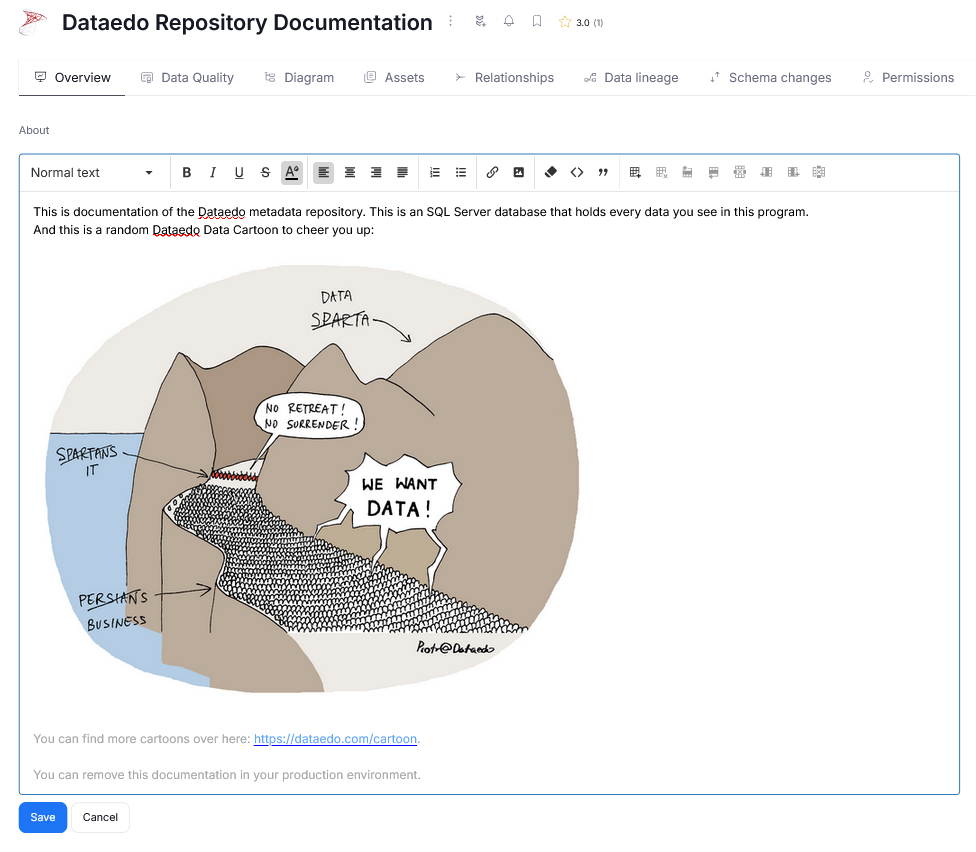
Each description has to be manually saved before it can be seen by other users in your organization. Unsaved descriptions will have an orange indicator [a] above them, and can be kept using the save button [b]

Unsaved changes are stored for the user in-between logins. This means, that even if you close the tab or log out of Dataedo before saving, when you return you will be able to continue editing the description from where you left off.
Description capabilities
Descriptions are built out of blocks. A new block can be started by typing / and selecting a command. Each block corresponds to a certain feature supported in our rich text editor. In this section of the article let us construct a potential description for a Places in New York City table, to showcase the description editor's capabilities.
Headings
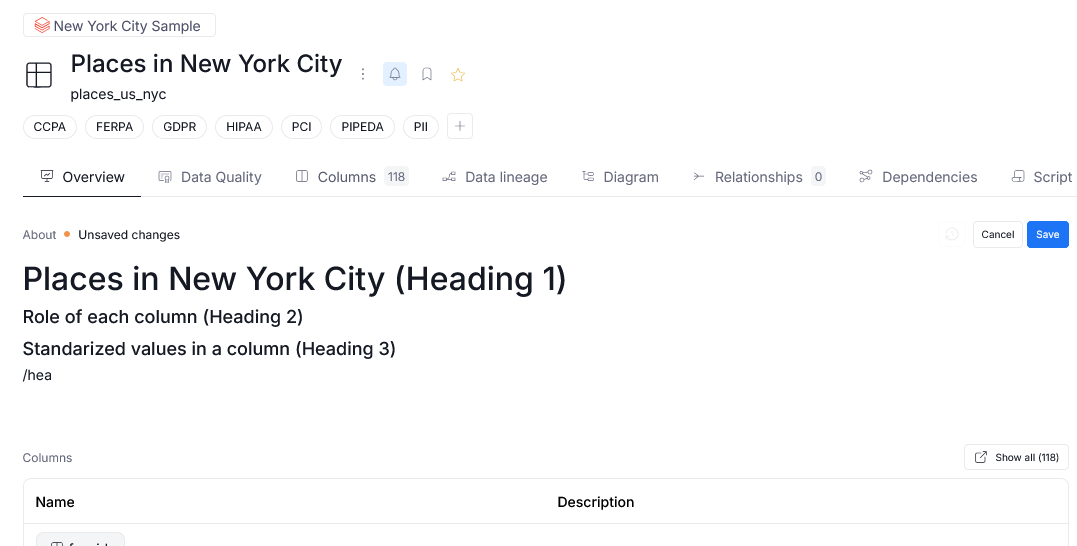
There are three types of headers supported in Dataedo — \Heading 1, \Heading 2 and \Heading 3. They are simply headings of varying size (and thus prominence) which you can use to better structure long-form descriptions.
Text
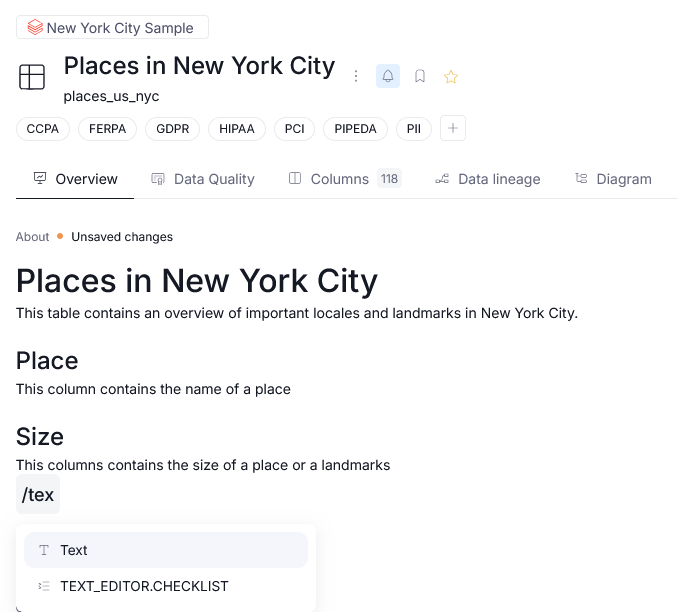
This type of block contains regular, plain text. This is also the type block that will be selected by default, if you just start typing without using any slash commands. Text blocks supports regular markdown syntax.
Lists
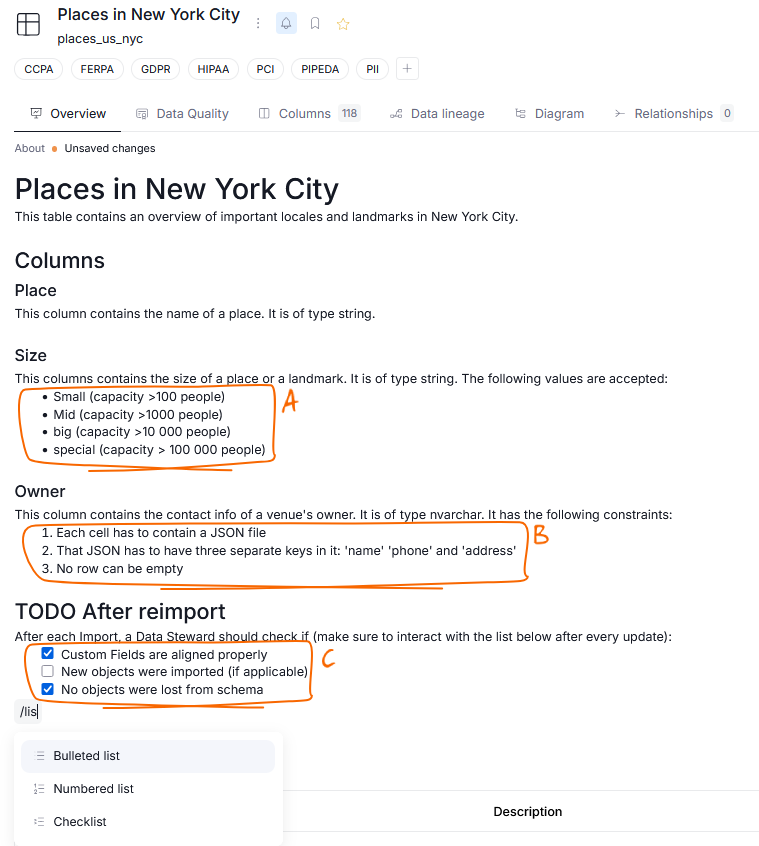
List blocks allow you to easily index information within your description. There are currently three supported list types /bulleted list [a] organizes all items in a list with bullet points, while /numbered list [b] does so using ordered, numbered items. Finally /checklist [c] allows you to create interactive, clickable checklists, where you can mark each item according to its status.
Tables
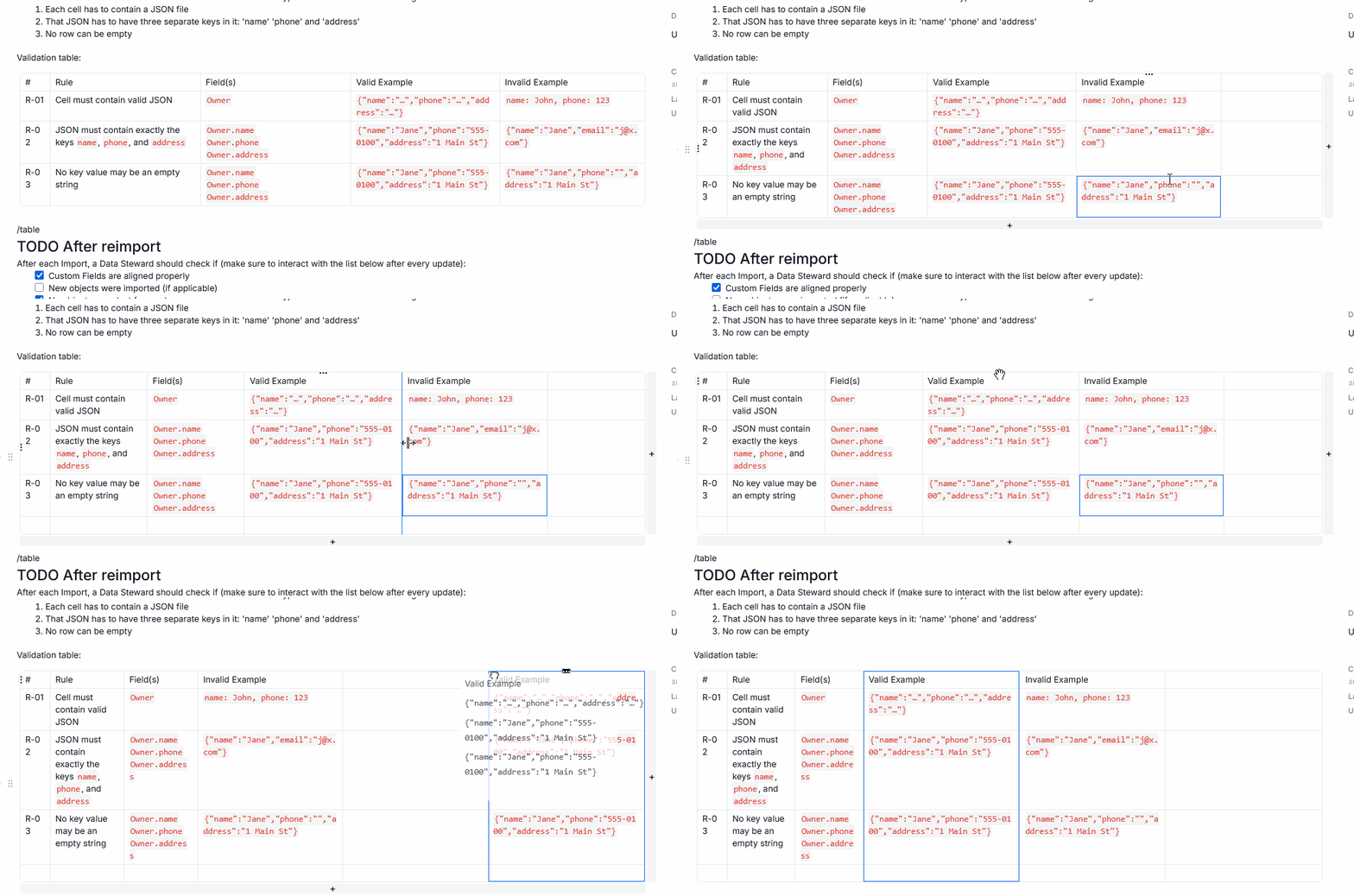
The /table block lets you create tabular items within your description.
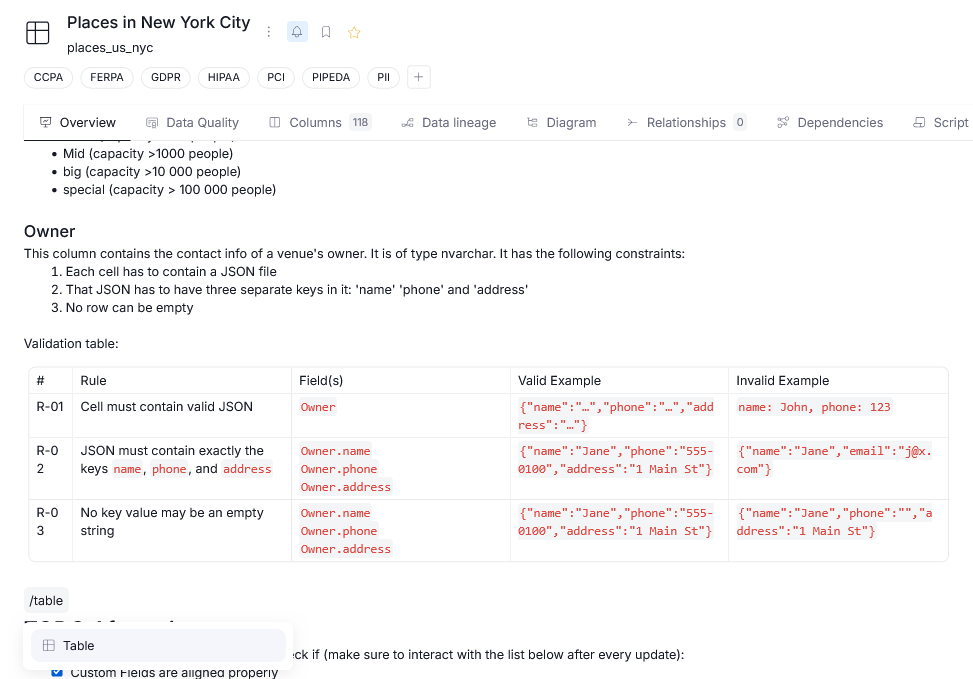
A table starts out in a 2x2 format. You can add rows and columns to it, using + icons. You can also resize columns and rows by clicking and dragging their edges. Finally, you can re-arrange columns.
Banners
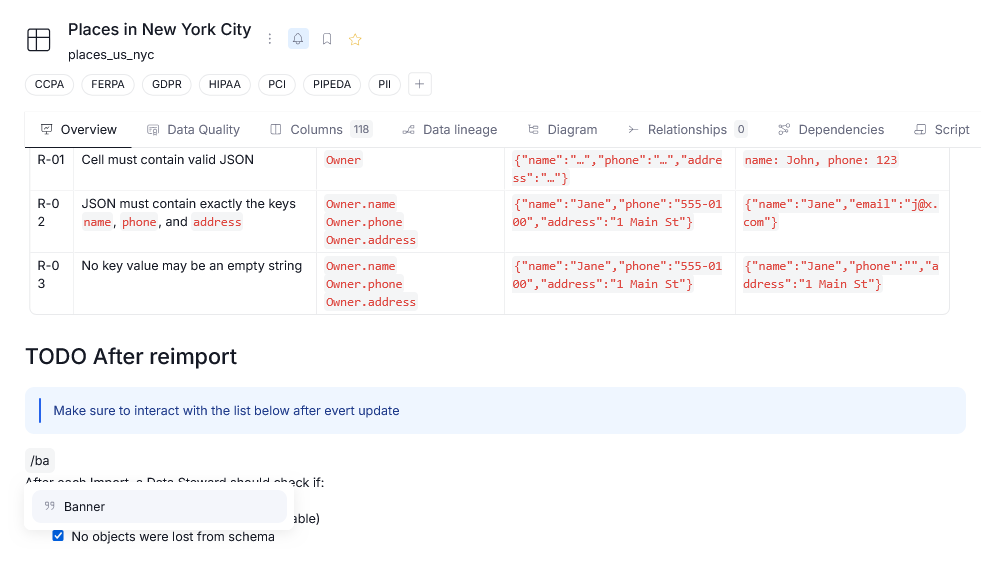
The /Banner block lets you highlight a message anywhere in the description, bringing visual attention to important details. Use it for warnings, tips or reminders to others in your organization.
Code Snippets
The /Code snippet block allows you to put code elements in your description, retaining its syntax properties, and following highlighting conventions. Use it when a piece of code or a script can help understand the purpose of an element.
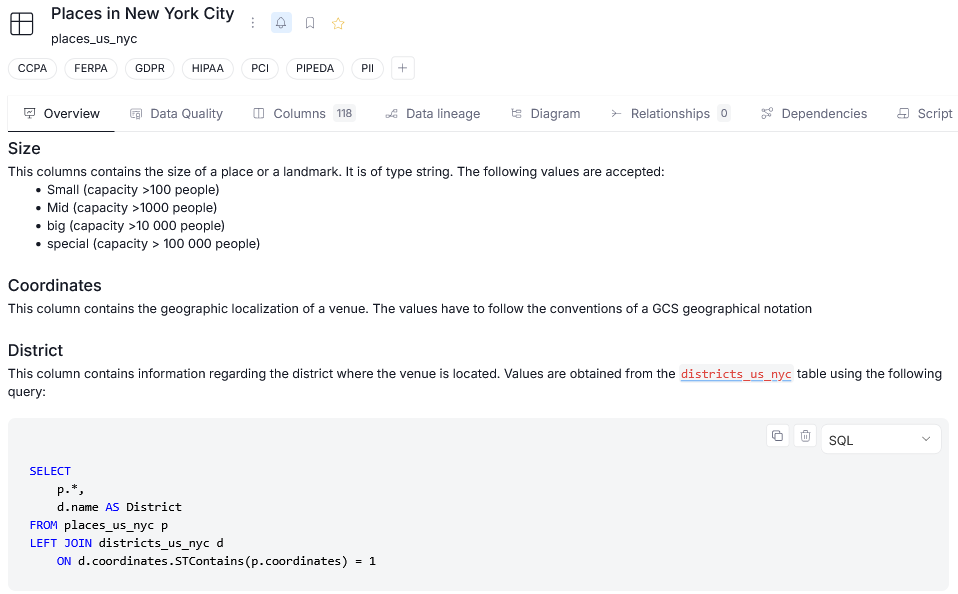
If you want to retain appropriate syntax highlighting, you should change the code convention used in a code snippet block. This can be done using a drop-down in its top right corner.

Charts
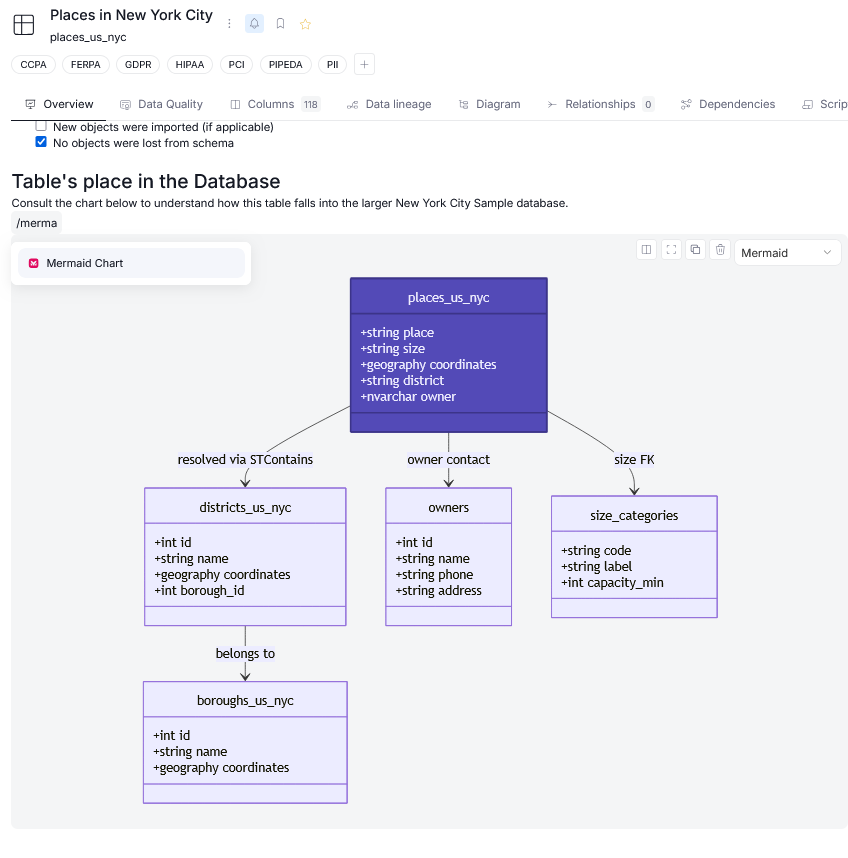
You can use Mermaid syntax to generate charts and diagrams in your descriptions. To do that, use a /Mermaid chart block. These blocks are a shorthand for a Code Snippet block, with Mermaid pre-selected as a syntax language. This allows for charts to be generated live based on your mermaid script.
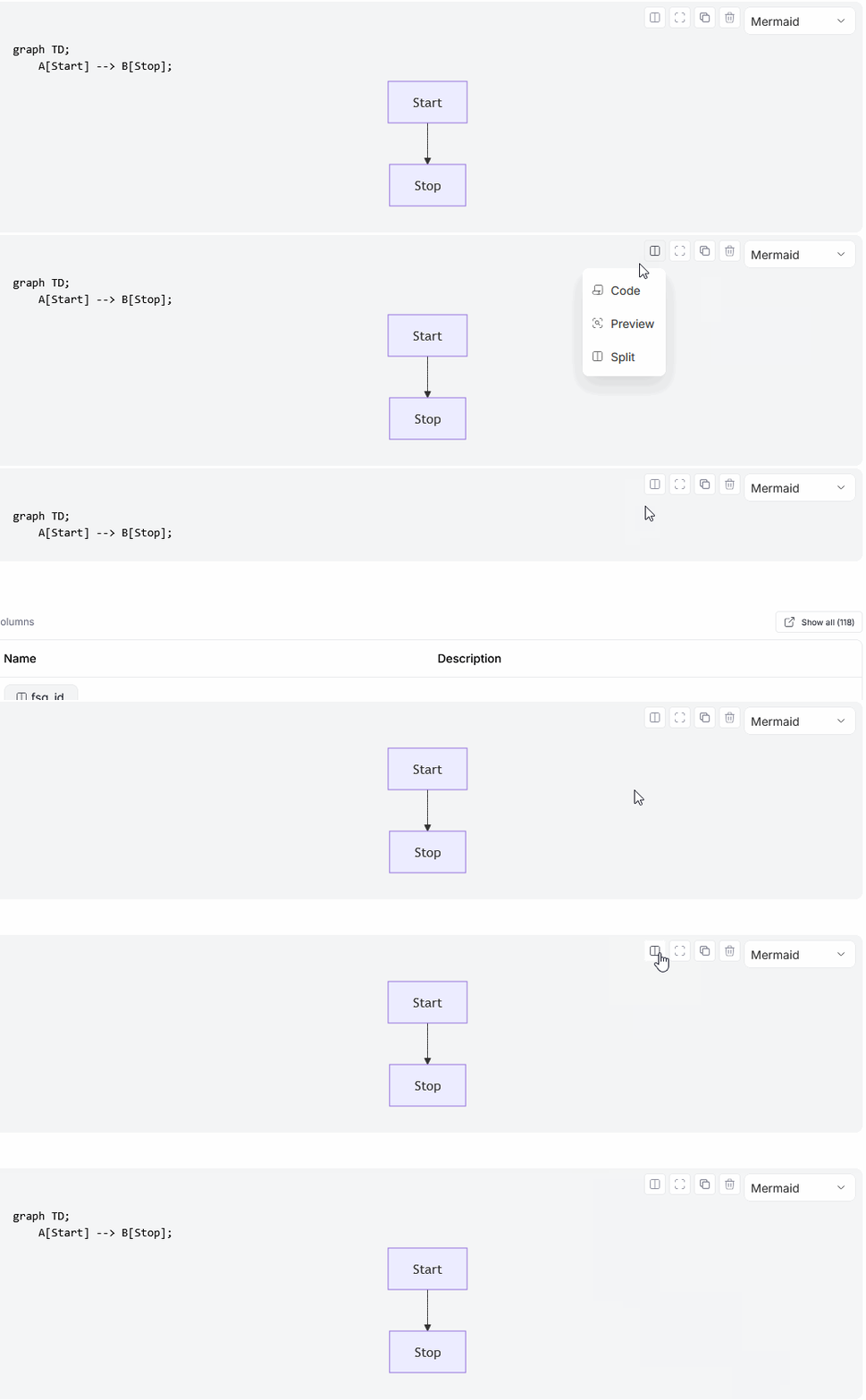
There are three modes of display you can choose for your mermaid chart:
- Code will show only the mermaid script with no artifact
- Preview will show only the artifact (chart/diagram), hiding the code from viewers
- Split shows both the code and the artifact
You can choose the display mode, using the block's menu icon.
Text Formatting
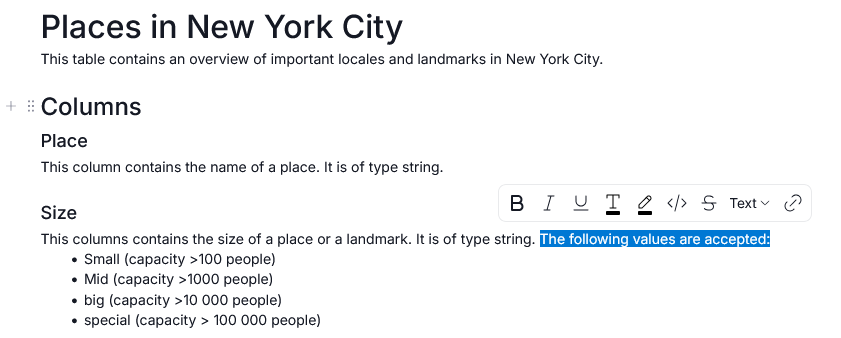
Text elements (headings, list, banners, and text block) can have additional text formatting. The formatting can be done using markdown syntax, or a GUI mode known from most mainstream text editors — just highlight the part of text you want to format, and a menu will show up.
Photos
Photos can be put into your description by simply pasting them in. The photo will be added as a separate text block, and retain its original file format.
Column Descriptions
Columns support rich text, without photos. You can still take advantage of features like banners, bolding, italics, etc.
Descriptions will be shown as plain text when viewing columns en masse on grids. When you open a column's asset page, however, you will see the full description.
Plain text descriptions
Certain objects support only plain text descriptions. These are:
- parameters
- keys
- relations
- triggers
Plain text descriptions are exactly what they sound like — descriptions, that can contain only regular, text input. They behave similarly to text block used in regular rich-text descriptions in Dataedo.

